Custom Data
Define your own typed fields and folders, hold per-client values with history and a reveal step for secrets, and map fields to services and plans.
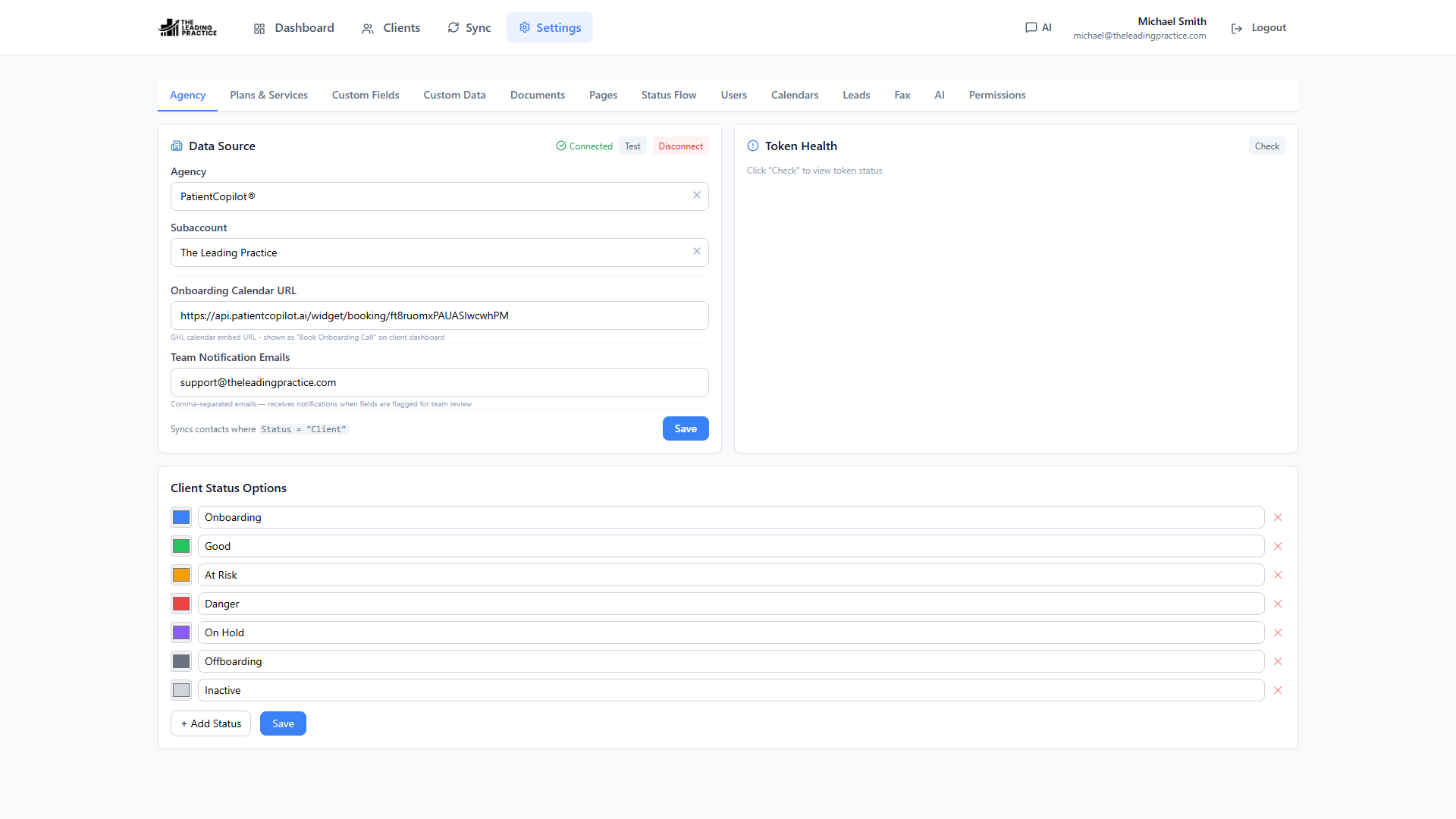
Model the data your agency actually keeps
Every agency holds data the CRM has no field for. The client’s hosting registrar login. Their GBP verification state. The margin on their retainer. Which internal person owns them. Where the logo files live.
Custom Data is where that lives — structured, not in a spreadsheet.
Typed fields, in folders
Define your own fields with real types, and organize them into folders so a client record with a hundred fields is still navigable. Give each a friendly name, a description and a required flag; the same field configuration that drives onboarding drives this.
Values with a history — and a reveal step for secrets
Each client carries its own values. Every value keeps its history, so a changed credential or a changed scope note is traceable. Secret values are held behind an explicit reveal step, which means a credential is something a person deliberately looked at — and that is recorded — rather than something sitting in plaintext in a channel where forty people can scroll past it.
Maps, so the right team sees the right fields
Two maps do the routing:
- Field → service. A field belongs to Website, SEO, Paid Ads, Social or Email. It shows up in that service’s tab, and not in the others.
- Plan → service. A plan bundles the services included in it, and its retail total is summed from them.
Together, that means a client on a plan shows exactly the fields relevant to the services they are actually buying, to exactly the people delivering them.
Questions about custom data
How is this different from GoHighLevel custom fields?
It complements them. GoHighLevel custom fields and custom values are synced two ways. Custom Data adds agency-specific structure on top — typed fields, folders, per-value history, secret reveal, and maps that decide which team sees which field.
Can I store client credentials?
Yes. Per-client custom values support a reveal endpoint for secrets, with history, so credentials are stored deliberately and access is auditable rather than pasted into a Slack thread.
Why map fields to services?
So the SEO team opens a client and sees SEO fields, and the ads team sees ads fields. Large field sets stay usable when each role only sees its own slice.
See Power CRM on your own GoHighLevel account
A 30-minute working session against a location you pick. We show onboarding, the sync conflict queue and AI field capture on real data — then you decide.